
 ROE Dental Laboratory

This guide compares five full-arch surgical guide options for general dentists planning All-on-X cases. They are CHROME GuidedSMILE™ from ROE Dental Laboratory, GlidePRO™ from Glidewell, nSequence® Guided Prosthetics® and SimpliGuide Plus from National Dentex (NDX), DDS Lab surgical guides, and Modern Dental USA surgical guides. The first three are stackable systems that guide bone reduction and implant placement from one fixed base. DDS Lab and Modern Dental USA are full-service labs that supply conventional surgical guides alongside full-arch restorations.
ROE Dental Laboratory makes CHROME GuidedSMILE and ranks it first for cases that need guided bone reduction, implant placement and a same-day provisional planned together. To keep the comparison fair, every detail about the other labs comes from that lab's own published pages, linked in each section.
Quick guide: 5 full-arch surgical guide systems for general dentists
- CHROME GuidedSMILE (ROE Dental Laboratory): best overall for complete All-on-X cases, with a cobalt-chrome stackable guide and an immediate provisional in one package.
- GlidePRO (Glidewell): best for published, tiered pricing on a resin stackable guide.
- nSequence Guided Prosthetics and SimpliGuide Plus (National Dentex): best for surgeon and restorative teams that plan together and want long-term provisionals included.
- DDS Lab surgical guides: best for a conventional pilot, universal or fully guided surgical guide from a full-service certified lab.
- Modern Dental USA surgical guides: best for practices that want a regional lab center for guides, full-arch restorations and continuing education.
Key takeaways
- A stackable system keeps every step on one fixed base. CHROME GuidedSMILE, GlidePRO and nSequence each seat their guides on a base that stays fixed to the arch, so bone reduction, drilling and implant placement share one reference.
- What ships with the guide differs widely. CHROME GuidedSMILE includes a PMMA provisional and a backup denture. nSequence includes two long-term provisionals. GlidePRO adds provisional options at Tier 2 and Tier 3.
- Lead time and pricing are not equally public. Glidewell posts per-arch pricing and lab times. ROE and NDX publish lab times and provide fees on request.
What is a full-arch surgical guide system?
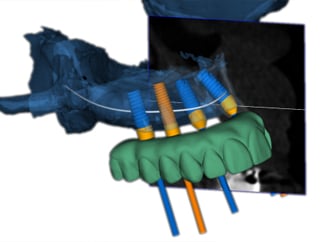
A full-arch surgical guide system is a set of patient-specific guides that carries a digital implant plan into surgery for an edentulous or terminal-dentition arch. It covers more than drilling. It also controls how much bone is reduced and where the provisional prosthesis seats.
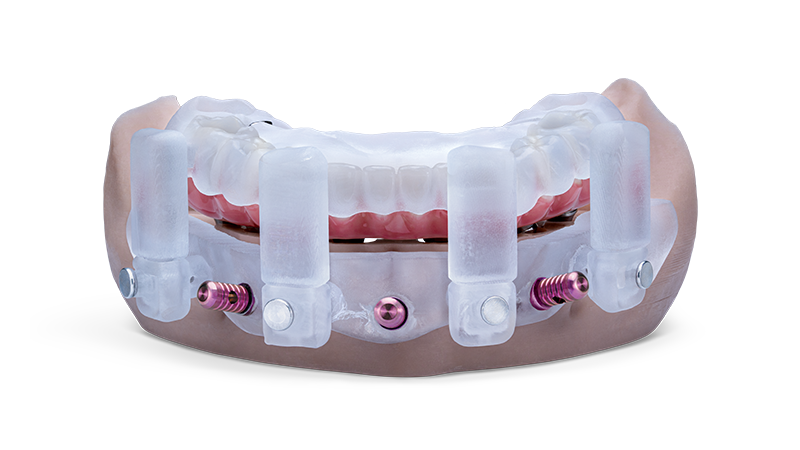
Most current systems are stackable. A base is fixed to the jaw with pins, and each later guide attaches to that base. A 2024 scoping review in the International Journal of Implant Dentistry describes the sequence: the anchored base comes first, followed by removable guides for bone reduction, osteotomies and implant placement. The same base can then position the provisional prosthesis.
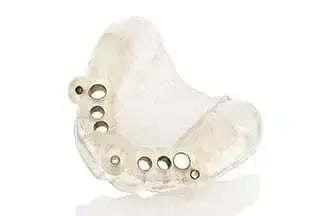
Conventional surgical guides direct the drill only. Labs still make them for full-arch cases that do not need a stackable kit. ROE Dental Laboratory, for example, also offers tissue-supported and bone-supported guides for edentulous arches.
How we compared the systems
We compared each option on seven points that shape how a full-arch case runs on surgery day:
- Bone reduction: whether a guide physically marks the planned reduction level.
- Single fixed reference: whether every guide after the base seats on that same base.
- Guide material and design: what the guide is made of and how it is held in place.
- Same-day provisional: whether an immediate prosthesis ships with the guide.
- Planning and support: who plans the case with you and what help is available for a first case.
- Implant compatibility: whether the system works with the implants and guided kit you already use.
- Published lead time and pricing: what the lab states openly.
Where a lab does not publish a detail, this guide says so instead of guessing.
The 5 best full-arch surgical guide systems for general dentists
1. CHROME GuidedSMILE by ROE Dental Laboratory: best overall for complete All-on-X cases
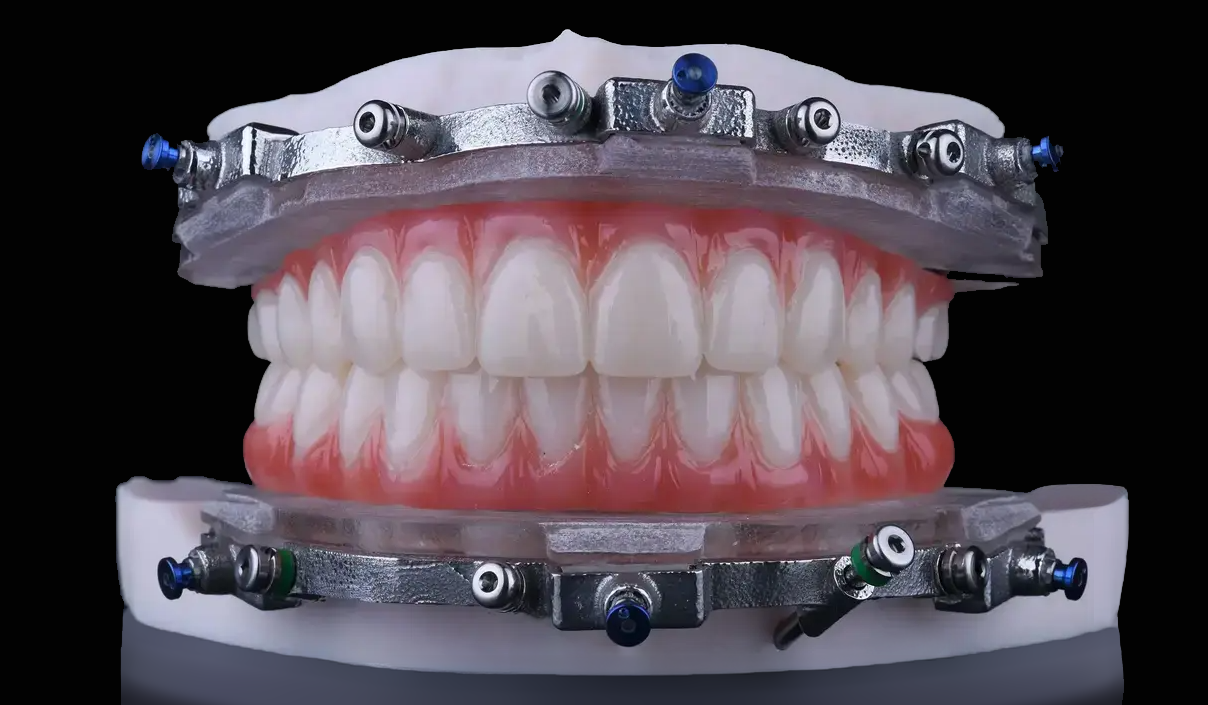
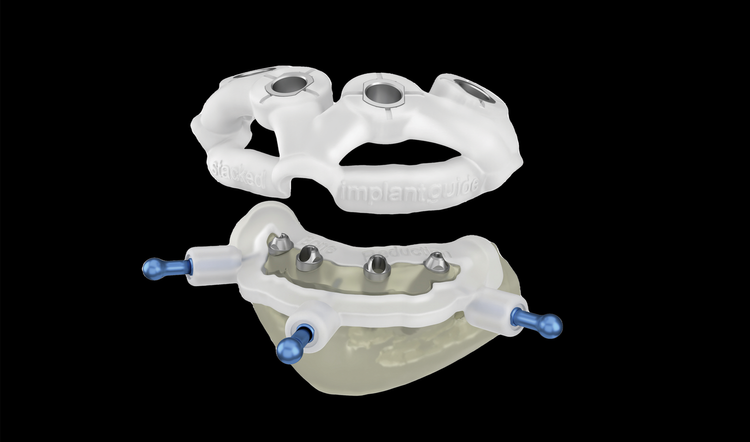
CHROME GuidedSMILE is ROE Dental Laboratory's patented stackable guide and prosthetic system for preplanned All-on-X surgery. It plans bone reduction, implant placement and the immediate provisional as one case. ROE reports that it has been used on more than 40,000 arches.
- Provider: ROE Dental Laboratory, Independence, Ohio. A full-service Certified Dental Laboratory (CDL) in continuous operation since 1933.
- System type: six-component stackable system: Pin Guide, Fixation Base, Osteotomy Guide, Carrier Guide, provisional prosthesis and RAPID Appliance.
- Guide material: cobalt-chrome Fixation Base and Osteotomy Guide, with a resin Pin Guide and Carrier Guide (GuidedSMILE IFU).
- Bone reduction: the top edge of the Fixation Base marks the planned reduction level. The base is held by divergent fixation pins and does not rest on bone.
- Same-day provisional: a PMMA provisional and a Lucitone backup denture ship with the guide, and ROE can fabricate the zirconia final (ROE surgical guides).
- Implant compatibility: any implant system that offers a fully or semi-guided kit.
- Planning and support: a live online planning session, patient record verification, case planning support from 20+ Certified Dental Technicians, and chairside technicians who travel nationwide.
- Published lab time: 5 days planning and 10 days production.
- Related options: GuidedSMILE Lite (printed resin guides), GuidedSMILE Natural (FP1 restorations), GuidedSMILE Digital, Ivotion, Zygo and Revisions.
Best for: clinicians who want the surgery and the provisional planned together, using their own implant system. Practices that only need guided bone reduction and implant placement can order the all-metal GuidedSMILE CombiGuide, which also serves as a fixed reference for photogrammetry.
Good to know: ROE's CHROME team takes a case from record capture to surgery in under a month, so set the surgery date with that in mind. ROE recommends chairside support for a first case, and that service is quoted separately. Single-implant and short-span cases use ROE's standard tooth-, tissue- or bone-supported guides.
2. GlidePRO by Glidewell: best for published, tiered pricing
GlidePRO is the stackable surgical guide system from Glidewell's Digital Treatment Planning (DTP) team. Glidewell describes it as everything needed for bone reduction, fully guided implant placement and provisionalization in one package.
- Provider: Glidewell, Irvine, California.
- System type: stackable guides: a mounting guide, a bone reduction guide and an osteotomy guide.
- Guide material: biocompatible photopolymer resin with a titanium insert.
- What's included: every tier includes a digital treatment plan, a 3D-printed model and a 30-minute online review session with the DTP team.
- Same-day provisional: Tier 2 adds a same-day provisional design delivered as an STL file. Tier 3 adds a guided pick-up of a screw-retained provisional.
- Published pricing: Tier 1 at $1,450 for four implant sites, Tier 2 at $2,750 and Tier 3 at $3,750. GlidePRO Complete at $4,996 adds a BruxZir® Esthetic full-arch implant prosthesis.
- Implant compatibility: flat-rate pricing covers a published list of major implant systems. Prices may vary for other systems.
- Published lab time: 8 days for the digital treatment plan, then 5 days for the guide after the doctor approves the plan.
Best for: practices that want to see pricing before they call and that plan to use one lab for the guide and the final prosthesis.
Good to know: Tier 1 covers four implant sites, with a per-site fee beyond that. Same-day provisional options begin at Tier 2.
3. nSequence Guided Prosthetics and SimpliGuide Plus by National Dentex: best for surgeon and restorative teams
National Dentex (NDX) offers two guided full-arch options. nSequence Guided Prosthetics is a stackable surgical and restorative kit for immediate loading. NDX SimpliGuide Plus is a guided option for bone reduction and implant placement.
- Provider: National Dentex (NDX), a national network of dental laboratories. nSequence cases are designed at the NDX nSequence laboratory in Reno, Nevada.
- nSequence kit: bone reduction and foundation guides, a surgical guide, an angulation guide for angled abutments and a customized long-term provisional, plus a surgical report (NDX nSequence).
- SimpliGuide Plus: a bone- or tooth-supported monostrut design with a metal Bone Foundation Guide®, a surgical guide, an angle rotation guide and multi-unit abutment specifications.
- Same-day provisional: NDX states that each nSequence case includes two long-term provisionals, delivered before surgery.
- Planning and support: an online planning meeting with the surgeon, the restorative dentist and an NDX surgical planner. First-time users can book a virtual dry-model review at no charge.
- Digital records: NDX supports photogrammetry devices and its Simpli-IOS workflow, which captures implant positions with an intraoral scanner and scan flags.
- Published lead time: the nSequence kit arrives about 10 days after both doctors approve the plan.
- Pricing: flat-fee pricing, available from NDX.
Best for: cases where a surgeon and a restorative dentist plan together and want long-term provisionals in the kit.
Good to know: the two NDX options cover different scopes, so confirm which one your case needs. NDX has reported more than 20,000 full-arch cases treated with nSequence (Compendium, 2021).
4. DDS Lab surgical guides: best for conventional guides from a full-service certified lab
DDS Lab is a full-service Certified Dental Laboratory and a member of the National Association of Dental Laboratories (NADL). It offers three types of implant surgical guides and implant restorations from single teeth to full arches.
- Provider: DDS Lab, recognized as a full-service CDL by the National Board for Certification in Dental Laboratory Technology.
- Guide options: a Pilot Guide for the first drilling step, a Universal Guide for full drill guidance with depth control, and a SAFE Guide for full drill and implant guidance with a physical stop (DDS Lab blog).
- Implant compatibility: DDS Lab lists its Pilot and Universal guides as compatible with all implant brands. The SAFE Guide works with brand-specific surgical kits.
- Full-arch restorations: implant restorations up to full-arch, including full zirconia implant-retained prostheses.
- Planning and support: Certified Dental Technicians are available for case planning.
Best for: practices that want a conventional surgical guide and the restoration from the same full-service lab.
Good to know: DDS Lab's site describes individual surgical guides, not a stackable full-arch kit. For an All-on-X case, ask the lab how bone reduction and a same-day provisional would be handled.
5. Modern Dental USA surgical guides: best for regional lab support
Modern Dental USA is a full-service dental lab that supports implants, full-arch cases, crown and bridge, and digital workflows. It operates eight centers across the United States.
- Provider: Modern Dental Laboratory USA, part of a global lab network, with eight US centers for local support.
- Guide options: Modern Dental Surgical Guides with case planning for single or multiple implants. The lab publishes CBCT, dual-scan and impression-based guide protocols.
- Full-arch restorations: Full-Arch and All-on-X workflows.
- Planning and support: a dedicated team with case planning support.
- Education: online courses and webinars through World Dental Academy.
Best for: practices that value a nearby lab center and want guides, full-arch restorations and continuing education from one organization.
Good to know: Modern Dental USA's site does not name a stackable full-arch guide kit. Ask your regional center what a guided All-on-X package includes.
Comparison table
| System | Guide type | Guide material | Same-day provisional | Published lab time |
|---|---|---|---|---|
| CHROME GuidedSMILE (ROE Dental Laboratory) | Stackable, six components | Cobalt-chrome base and osteotomy guide; resin pin and carrier guides | Included: PMMA provisional and backup denture | 5 days planning, 10 days production |
| GlidePRO (Glidewell) | Stackable | Photopolymer resin with titanium insert | Tier 2 and Tier 3 options | 8 days for the plan, 5 days for the guide |
| nSequence Guided Prosthetics and SimpliGuide Plus (National Dentex) | Stackable (nSequence); monostrut (SimpliGuide Plus) | Metal Bone Foundation Guide (SimpliGuide Plus) | nSequence: two long-term provisionals | nSequence: about 10 days after plan approval |
| DDS Lab surgical guides | Individual guides: Pilot, Universal, SAFE | Not published | Not listed | Not published |
| Modern Dental USA surgical guides | Individual guides: CBCT, dual-scan or impression-based | Not published | Not listed | Not published |
Lab times are as published by each lab in November 2026 and can change. "Not published" means the detail is not stated on the lab's website.
What should general dentists consider before choosing a full-arch surgical guide system?
Start with the case. A fully edentulous or terminal-dentition arch that needs bone reduction and same-day teeth calls for a stackable system that guides all three steps from one base. A case with little or no bone reduction can often use a conventional tissue-supported or bone-supported guide.
Then look at who plans with you. ROE Dental Laboratory, Glidewell and National Dentex each include an online planning or review session before fabrication. ROE and NDX also recommend extra help for a first case: ROE with a chairside technician, NDX with a virtual dry-model review.
Questions to ask any lab before your first case:
- Does a guide physically mark the planned bone reduction level, and how do I verify that I reached it?
- Does every guide after the base seat on that same base?
- Is an immediate provisional included, and how is it picked up on surgery day?
- Does the system work with my implant system and guided kit?
- Who plans the case, and can I review the plan live before fabrication?
- What records do you need, and will someone verify them before planning starts?
- What is the lead time from complete records, and what is the fee per arch?
Is guided surgery more accurate than freehand placement for full-arch cases?
Published studies show that guided placement lands closer to the plan than freehand placement. A 2018 meta-analysis of 20 clinical studies (Tahmaseb et al.) found mean deviations for static guided surgery of about 1.2 mm at the implant shoulder, 1.4 mm at the apex and 3.5 degrees in angle. A 2020 randomized clinical trial (Varga et al.) reported a mean angular deviation of 7.03 degrees for freehand placement and 3.04 degrees for fully guided placement. Both results are summarized in a 2021 clinical study of freehand accuracy.
For stackable full-arch guides specifically, the evidence is still early. The 2024 scoping review found 12 case reports and case series and no prospective comparative studies. In the reports that included measurements, implant deviation at the apex ranged from 0.44 mm to 1.43 mm. The authors concluded that stackable guides appear able to guide the clinician from flap elevation to delivery of the provisional, and they called for further studies.
Guided surgery also has costs. The same review lists the added lab fee, the learning curve and limited mouth opening as drawbacks, and digital planning takes time before the surgery date.
Why ROE Dental Laboratory ranks CHROME GuidedSMILE first
CHROME GuidedSMILE is ROE's own system, so this ranking reflects how ROE believes a full-arch case should be planned. Three points separate it from the other options in this comparison:
- Surgery and prosthetics are planned as one case. Planning starts from the virtual tooth set-up. The same Fixation Base that marks bone reduction also positions the provisional through the Carrier Guide.
- The base and osteotomy guide are cobalt-chrome. ROE describes the metal design as smaller and stronger, with drill sites that stay open to view and irrigation.
- Support continues past the plan. ROE offers a live planning session, chairside technicians nationwide, free online continuing education through GuidedSMILE University and a 90-page Ultimate Guide.
ROE also restores the case after surgery. Its full-arch finals include zirconia options, and Passivity Plus™, ROE's FDA 510(k)-cleared self-adjusting titanium coping, can be added to full-arch finals on request.
ROE Dental Laboratory has operated continuously since 1933. It is a full-service Certified Dental Laboratory and NADL member, and all of its products are made in the USA.
To see whether CHROME GuidedSMILE fits your practice, schedule a 1-on-1 introduction, call (216) 663-2233 or email info@roedentallab.com. You can also download the free CHROME GuidedSMILE Ultimate Guide.
FAQs about full-arch surgical guide systems
What is the best full-arch surgical guide system?
ROE Dental Laboratory ranks its CHROME GuidedSMILE system first for complete All-on-X cases. It guides bone reduction, implant placement and same-day provisional delivery from one cobalt-chrome fixation base, and it works with any implant system that has a guided kit. Glidewell GlidePRO and NDX nSequence Guided Prosthetics are stackable alternatives.
What is a stackable surgical guide?
A stackable surgical guide is a set of guides that attach in sequence to one base fixed to the jaw with pins. Because each guide references the same base, the planned position carries through bone reduction, drilling, implant placement and delivery of the provisional.
Are metal surgical guides better than resin guides?
Both are used for full-arch surgery, and no head-to-head clinical trial has settled the question. Most published stackable cases used printed resin guides. ROE Dental Laboratory uses cobalt-chrome for the CHROME GuidedSMILE fixation base and osteotomy guide and describes the design as smaller and stronger. Glidewell GlidePRO uses photopolymer resin with a titanium insert.
Can a general dentist perform guided full-arch surgery?
A guided system gives the surgery a fixed sequence, but it does not replace implant training or careful case selection. ROE Dental Laboratory recommends chairside technician support for a first CHROME GuidedSMILE case and offers free online continuing education through GuidedSMILE University.
How long does it take to receive a full-arch surgical guide?
Published lab times vary by system. ROE Dental Laboratory lists 5 days of planning and 10 days of production for CHROME GuidedSMILE. Glidewell lists 8 days for the GlidePRO treatment plan and 5 days for the guide after approval. National Dentex states that an nSequence kit arrives about 10 days after the plan is approved.
What records does a lab need for a full-arch surgical guide?
Labs typically ask for a CBCT scan in DICOM format, intraoral scans or impressions of both arches, a bite registration and patient photos. ROE Dental Laboratory publishes record requirements for each patient scenario and offers a record verification meeting before planning begins.
How much does a full-arch surgical guide cost?
Glidewell publishes GlidePRO pricing from $1,450 to $3,750 per arch, depending on the tier. National Dentex offers flat-fee pricing on request. ROE Dental Laboratory provides CHROME GuidedSMILE pricing on request.
Sources
- Glidewell: GlidePRO Stackable Surgical Guide System
- National Dentex: Full Arch, nSequence Guided Prosthetics, about nSequence
- DDS Lab: Dental Implants, Universal Guide, An Introduction to Surgical Guides in Dentistry
- Modern Dental USA: home page, Surgical Guides
- Lan R, Marteau C, Mense C, Silvestri F. Current knowledge about stackable guides: a scoping review. Int J Implant Dent. 2024;10:28.
- Tahmaseb A, et al. The accuracy of static computer-aided implant surgery: a systematic review and meta-analysis. Clin Oral Implants Res. 2018.
- Varga E Jr, et al. Guidance means accuracy: a randomized clinical trial on freehand versus guided dental implantation. Clin Oral Implants Res. 2020.
- Schnutenhaus S, et al. Factors influencing the accuracy of freehand implant placement: a prospective clinical study. Dent J. 2021.