Skip to the main content.

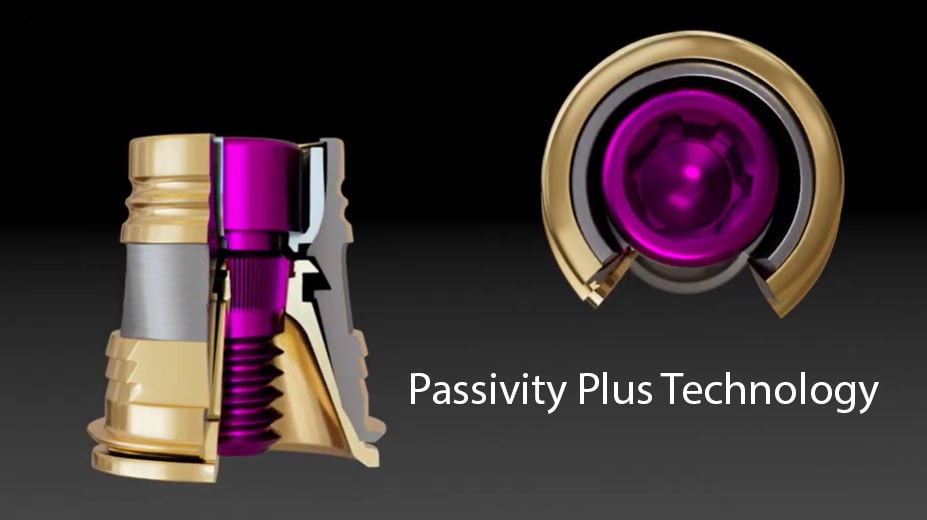
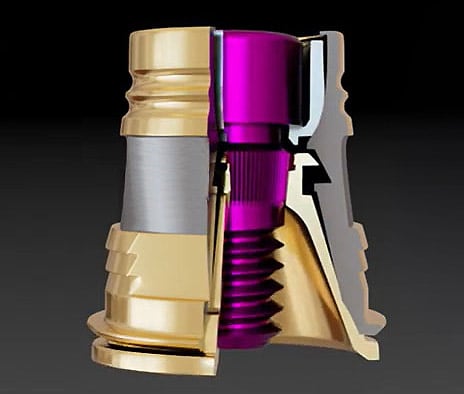
Passivity Plus Technology


Lack of Passivity = Stress in Full-Arch

In full-arch implant restorations, achieving true passivity is difficult. From impression capture, scanning, model fabrication, to prosthesis manufacturing, minor discrepancies accumulate at every step. The prosthesis may look perfect, but when seated, it fights against itself.

The consequences are predictable and costly:

Screw Loosening - Non-passive prostheses create constant micro-stress on screws. The result? Repeated loosening, emergency appointments, and frustrated patients questioning their investment.

Prosthesis Fracture - Stress doesn't disappear; it transfers. When forces can't be absorbed by a passive fit, they concentrate in the prosthesis itself, leading to catastrophic failures and expensive remakes.

Bone Loss - The most insidious consequence. Chronic stress on implants accelerates peri-implant bone resorption, threatening the long-term survival of the entire restoration.

Passivity Plus helps elevate existing passivity to a higher level, benefiting both doctor and patient.

Passivity Plus

ILLUSTRATIVE ANIMATION

Passivity Plus Technology

Passivity Plus Technology

Clinical Benefits of
Passive+ Technology

  • True passive fit without compromise -  The self-adjusting mechanism automatically compensates for minor misfits during seating.
  • Universal workflow compatibility - Works with any record-capture method (scanning, photogrammetry, grammetry, stone models) and any framework material (zirconia, titanium, PMMA, hybrid). 
  • Decreased prosthesis fracture risk - The self-adjusting mechanism absorbs stress that would otherwise concentrate in the prosthesis framework.
  • Fewer remakes and repairs -  Cases that fall within normal manufacturing tolerances but would fail passive fit testing with conventional components can proceed successfully.
  • Virtual elimination of screw loosening -  The 5-degree conical cold-welding mechanism creates a friction-locked connection at 25 Ncm that resists loosening under functional loads.
  • Fully reversible and serviceable - The cold weld releases when the screw is loosened, restoring flexibility to the pivotable cap.
  • Predictable, repeatable seating protocol - A simple, standardized technique applies to every case: partial engagement of all screws, allow self-adjustment, then final torque in cross-pattern to 25 N·cm.
  • No bite opening or occlusal distortion - Micro-scale adjustments, less than 2 degrees, at the micron level, have no clinically significant impact on vertical dimension. The prosthesis seats in its designed occlusal scheme without the distortion that occurs when forcing non-passive frameworks into place.

Key Specifications Table

Specifications Details
Material Premium Grade 5 Titanium (Ti-6AL-4V-ELI)
Recommended Torque 25 N·cm
Maximum Safe Torque ~30 N·cm
Internal Taper (base) 5° per side
Screw Body Taper 5° per side (10° total)
Screw Body Surface Smooth (no retention slots)
Cold Weld Location Screw body to internal base walls
Key Patent Feature Washer around screw head
Driver Type 1.25 mm Hex / UniGrip
Adjustment Range <2 degrees; micron-scale movements
Total Components 4 pieces
Screw Indication One-time use (regulatory); durable for 5-10 uses
FDA Status 510(k) cleared, Class II

1. External Adjustable Cap

Provides external retention and adhesive bonding.

2. Screw Fixation

Screw securing the assembly.
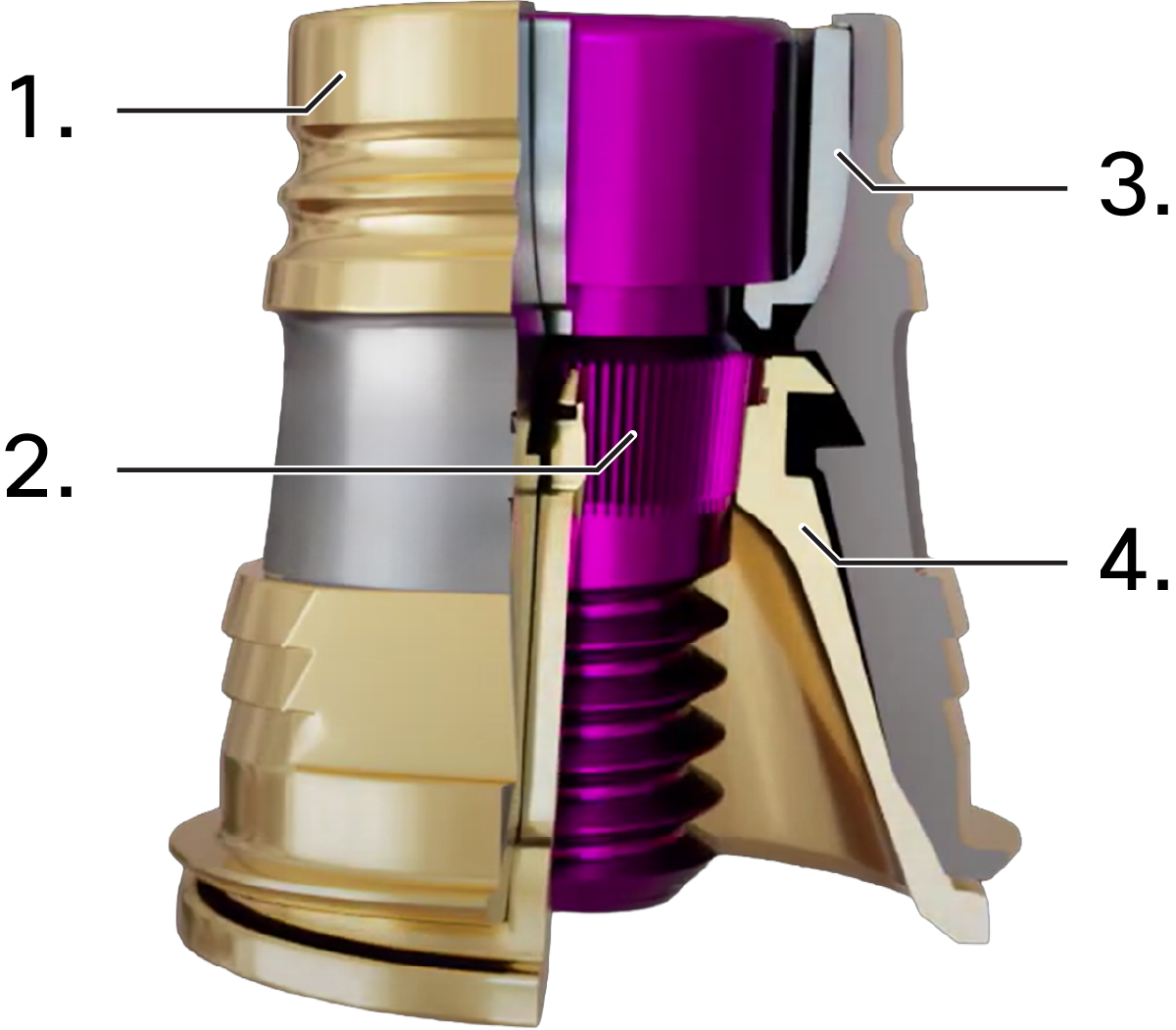
3. Concial Body

Locks the entire system via cold welding, ensuring mechanical stability and preventing screw loosening.

Passivity Labeled

4. Screw Washer

Stabilizes the screw position by compensating for inner component movement, preventing the screw from recentering during function.

5. Inner Cap

Slightly engages within the external cap, creating a fully seated interface between components.
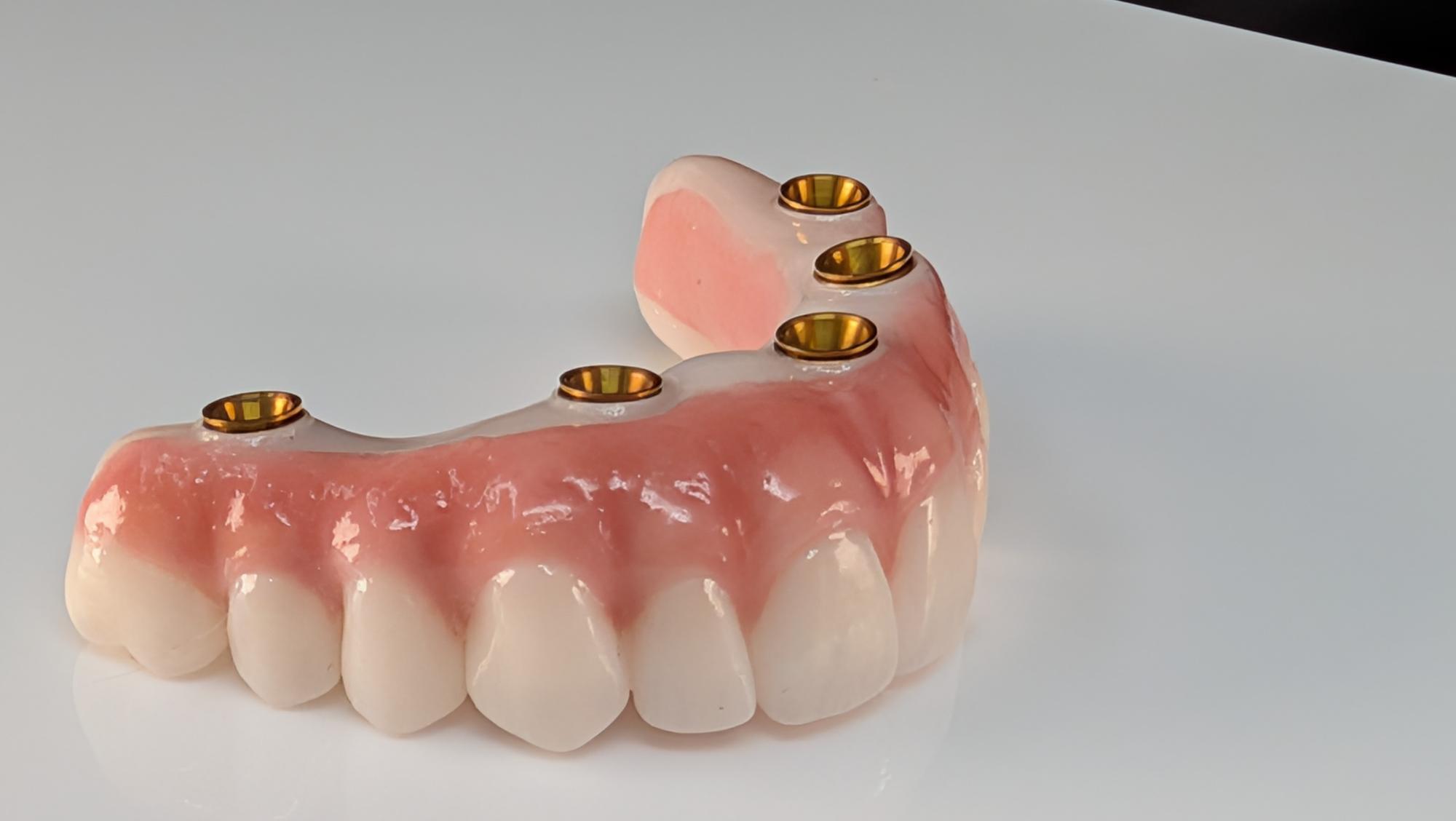
Passivity Plus in a Full Arch

Frequently Asked Questions

Frequently Asked Questions

Have question? We are here to help

General Overview
Technical Specifications
How Passivity Plus Works
Clinical Use
Digital Workflow & Compatibility
Safety, Regulatory & Maintenance

No results found.

What is Passivity Plus™?

Passivity Plus™ is a self-adjusting titanium base designed for use with multi-unit abutments in full-arch implant restorations. It features a pivotable self-adjusting cap interface that compensates for minor misfits during prosthesis seating, helping achieve a passive, tension-free fit.  The system consists of four integrated components:

  • the base body

  • self-adjusting cap

  • specialized screw

  • patented washer

They all work together in a compact design to eliminate stress-related complications.

What problem does Passivity Plus™ solve?

Passivity Plus™ addresses the persistent challenge of achieving passive fit in full-arch restorations. When prostheses don't seat passively, stress is transferred to implants, which can lead to screw loosening, prosthesis fracture, and bone loss.

The self-adjusting mechanism compensates for minor misfits that accumulate from digital stacking, milling, and sintering, digital and analog impression capture, model fabrication, and ongoing machine calibration impossibilities

What does 'self-adjustable cap' in Passivity Plus mean?

The phrase 'self-adjustable cap' replaces instead of the more common 'Ti-base' terminology for strategic reasons:

  • Versatility: Indicates the component works in both digital and non-digital (manual)workflows
  • Differentiation: Distinguishes Passivity Plus™ from conventional Ti-base products
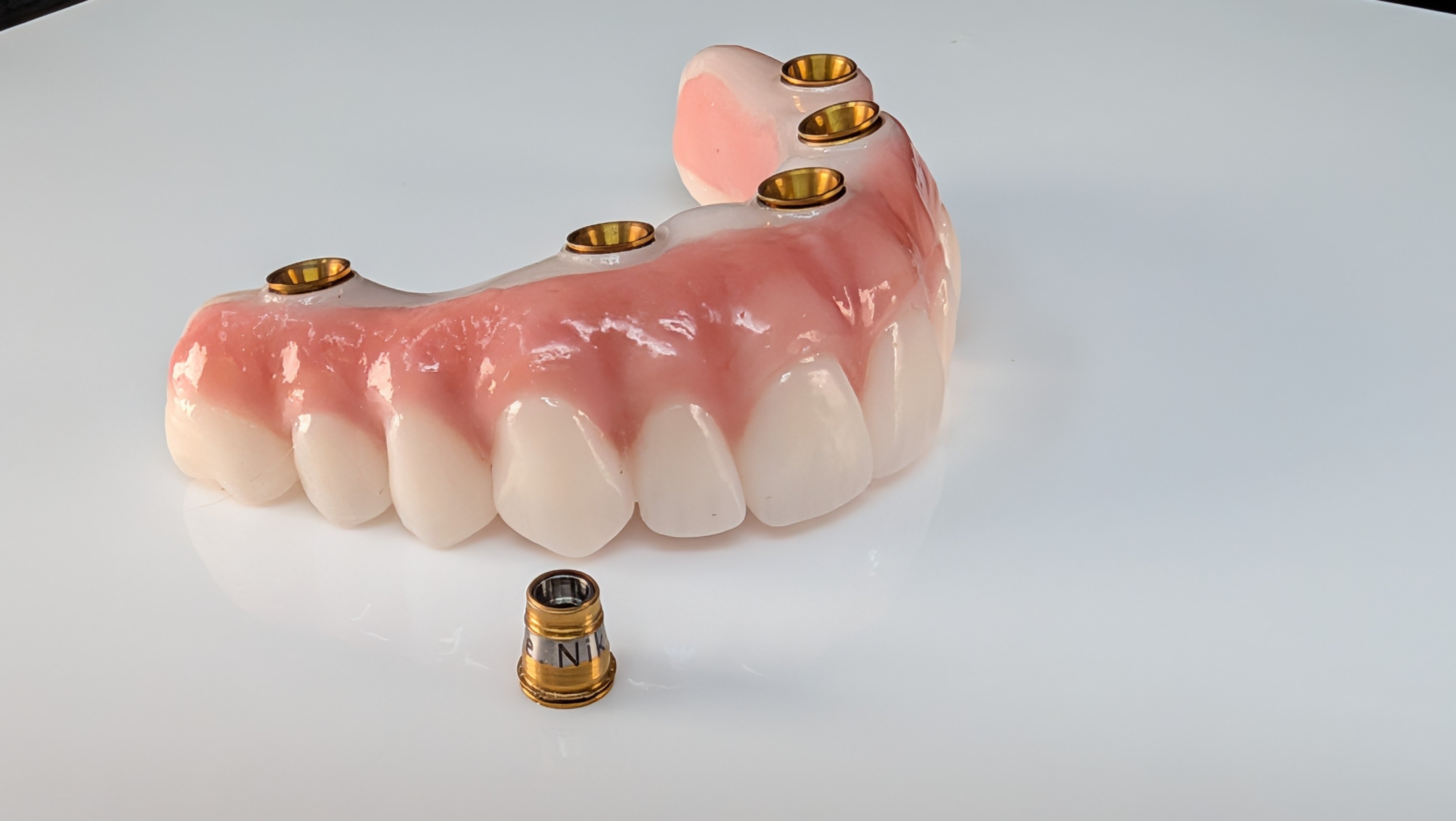
  • Function: The prosthesis is cemented onto the cap extra-orally, without the use of a traditional model, then connected to the MUA

The preferred terminology is 'pivotable, self-adjusting cap' as it most accurately describes the component's function.

What material is Passivity Plus™ made from?

Premium Grade 5 Titanium (Ti-6AL-4V-ELI). This is the same biocompatible alloy used in medical implants.

How many components make up Passivity Plus™?

Four pieces in a compact, integrated design:

  1. Base body: Connects to multi-unit abutment; contains 5° internal taper
  2. Pivotable adjustable cap:  Receives prosthesis cement; self-adjusts, then locks when torqued
  3. Screw: One piece; 5° body taper; smooth surface; creates cold weld
  4. Washer: Flexible element around screw head; key patent innovation

The inventor notes this was a significant engineering achievement: 'I worked very hard on it... to make all this mechanism, four pieces sitting in such a small part. The unique, and difficult development was the base’ resistance to sideways shift as the screw is tightened. The stress is centered due to the screw threading and the floating washer mechanism.’

What are the complete specifications of Passivity Plus™?

Specifications

Details

 Material

 Premium Grade 5 Titanium (Ti-6AL-4V-ELI)

 Recommended Torque

 25 N·cm

 Maximum Safe Torque

 ~30 N·cm

 Internal Taper (base)

 5° per side

 Screw Body Taper

 5° per side (10° total)

 Screw Body Surface

 Smooth (no retention slots)

 Cold Weld Location

 Screw body to internal base walls

 Key Patent Feature

 Washer around screw head

 Driver Type

 1.25 mm Hex / UniGrip

 Adjustment Range

 <2 degrees; micron-scale movements

 Total Components

 4 pieces

 Screw Indication

 One-time use (regulatory); durable for 5-10 uses

 FDA Status

 510(k) cleared, Class II

What are the key innovations of Passivity Plus™?

Innovation

Function

 Pivotable Self-Adjusting Cap

 Compensates for minor misfits during prosthesis seating

 Conical Cold-Welding Screw

 5° taper creates a cold weld at 25 N·cm,  eliminating screw loosening

 Patented Washer Design

 Prevents re-centering during torque, preserving adjusted position

How does the self-adjusting mechanism work?

Each Passivity Plus™ has a pivotable self-adjusting cap that allows micro-adjustment during screw tightening. The adjustment range is less than 2 degrees per base, operating at the micron scale — far less than depicted in educational animations.

When screws are partially engaged (not fully torqued), the caps can pivot freely to compensate for minor misfits between the prosthesis and implant positions. Once seated correctly, final torque locks the adjusted position.

How does the screw design prevent screw loosening?

The Passivity Plus™ features a conical screw design that creates a 'cold welding' effect:

  • Taper angle: 5 degrees per side (10 degrees total)
  • Mechanism: Conical screw engages matching internal taper under torque
  • Result: Friction-locked connection that virtually eliminates screw loosening

This is comparable to the cold-welding principle used in other dental and non-dental applications: it occurs between the screw body and the internal base walls rather than at the implant-abutment interface.

What is 'cold welding' in this context?

Cold welding refers to the mechanical joining of two precisely matched conical titanium surfaces (5° per side) pressed together under proper torque, creating an extremely tight, friction-locked connection.

This metal-to-metal engagement distributes load throughout the structure and prevents micromovement that leads to screw loosening.

It is NOT a permanent metallurgical bond — the screw releases normally when unscrewed, allowing the self-adjusting mechanism to reset and be engaged again.

How is Passivity Plus™ cold welding different from implant-abutment cold welding?
Aspect Traditional Conical Connection Passivity Plus
Cold weld location Between the implant and the abutment Between the screw body and internal base walls
When screw removed Abutment stays in the implant All components release
Effect Abutment stays 'stuck' Base components regain flexibility


The Passivity Plus™ cold welding is internal to the prosthetic component, allowing the self-adjusting mechanism to remain functional until final torque.

What is the washer, and why is it important?

The washer around the screw head is described by the inventor as 'the most important creative thing in all the patent' and 'the big game.'

The Problem: When any screw is tightened, the thread geometry naturally centers everything. Without intervention, these centering forces would negate the compensating adjustment achieved by the pivotable cap.

The Solution: The flexible washer allows the screw head to remain off-center (tilted) even when fully torqued. This means the adjusted/compensated position is maintained without stress transfer.

Visual confirmation: After full torque, the screw head may appear slightly tilted rather than perfectly centered - this is normal and indicates that the washer is functioning correctly.

How does Passivity Plus™ achieve a stress-free fit?

The patented washer design is the key to achieving passive fit:

  1. During seating: The pivotable cap adjusts to compensate for minor misfits
  2. During torque: The flexible washer absorbs centering forces from screw threads and cold welding
  3. After torque: The adjusted position is locked without transferring stress to surrounding components

Result: No stress on the body or surrounding structures — the prosthesis maintains its compensated position.

When should Passivity Plus™ be used?
  • New full-arch implant prostheses on multi-unit abutments
  • Cases where minor passive fit discrepancies are anticipated
  • Replacement of existing prostheses with minor fit issues
  • Cases using titanium bar substructures
  • Upgrades from conventional Ti-base systems
  • Switching from direct-to-MUA
When should Passivity Plus™ NOT be used?

Passivity Plus™ compensates for minor misfits - not major errors.

Do NOT use when:

  • Scan quality is poor: Visible shadows, artifacts, overlapping scan bodies, and significant data gaps
  • Prosthesis fit is grossly off: Excessive rocking/wobbling, misfit beyond minor range, 'crazy errors.'
  • Model accuracy is significantly compromised: Major impression errors, gross implant position discrepancies

As the inventor stated: 'We can fix for sure normal errors, not crazy errors.'

Does Passivity Plus™ eliminate the need for verification jigs?

In many cases, yes. Passivity Plus™ compensates for minor misfits that would otherwise require verification and correction. However, it is not a substitute for correcting major impression/model errors.

Verification jigs remain valuable for confirming implant positions in complex cases or when scan quality is questionable.

Can Passivity Plus™ be used on a prosthesis that has fractured?

Yes. Passivity Plus™ is specifically intended for repairing minor discrepancies without needing to start over. This makes it valuable for salvaging cases that might otherwise require complete remake.

Can I replace existing traditional Ti-bases with Passivity Plus™?

No.  Existing Ti-base copings have a different geometry. To use Passivity Plus™, capture new records, and the case will be fabricated with Passivity Plus™ components.

This is not a simple swap of components, yet it can use an existing prosthesis in many cases to fabricate the new prosthesis.

Can Passivity Plus™ be used with titanium bar substructures?

Yes, provided the framework allows for proper seating and torque. Real-world cases with titanium bars have been completed successfully with excellent results.

What is the recommended screw tightening sequence?
  1. Initial engagement: Hand-start each screw with 2-3 turns - just enough to engage threads
  2. Do not fully torque yet: Leave all screws partially engaged to allow free movement
  3. Allow self-adjustment: Give the pivotable caps time to find their compensated positions
  4. Progressive tightening: Use a cross-pattern to gradually tighten all screws
  5. Final torque: Torque each screw to 25 N·cm in an alternating pattern to activate cold weld

Critical: Do not torque individual screws to 25 N·cm before all screws are partially engaged. The self-adjusting mechanism needs freedom to compensate before it is locked.

Does Passivity Plus™ open the bite or affect occlusion?

No. The micro-movements are too small to affect occlusion. Each base moves only microns (less than 2 degrees). Even with 4-6 bases each making micro-adjustments, the cumulative effect does not raise the prosthesis.

Important: The Passivity Plus animation shows exaggerated movement for educational clarity. Clinical reality involves barely perceptible adjustments.

Is the Passivity Plus™ screw single-use?

Official guidance: The screw is indicated for single-use per standard regulatory requirements.

Practical considerations: The screw design can withstand multiple uses (5-10 times) without structural damage. The cold welding mechanism distributes torque stress to the screw body rather than the threads, providing durability, and resets with each loosening.

Recommendations:

  • Use professional judgment and inspect screws before any reuse
  • Look for: bending, scratches, thread damage, or any visible wear
  • When in doubt, use a new screw
Is it difficult to remove the screw after torquing?

No. Screw removal is straightforward:

  • Use a standard screwdriver to loosen
  • Initial resistance is ~15-20% higher than a conventional screw (cold weld release)
  • Once past the cold weld zone, the screw backs out easily
  • Screw may remain attached to screwdriver tip — this is normal

The 'cold welding' is a mechanical friction lock, not a permanent bond. It releases predictably when loosened.

Is Passivity Plus™ compatible with digital workflows?

Yes. Passivity Plus™ offers universal digital compatibility.

What is the complete digital workflow?

Passivity Plus™ works with virtually any input method for full-arch case records:

Record capture (any method) → software → Exocad → Design prosthesis → Bond Passivity Plus™ components

Supported input methods:

  • Any full-arch scan body system 
  • Photogrammetry output
  • Grammetry output
  • Stone models
  • Fit verification jigs
What is the minimum thickness required for zirconia around Passivity Plus™?

Follow standard CAD software (exocad) framework design rules. Passivity Plus™ does not require special thickness considerations beyond normal prosthetic design parameters.

The adjustable cap shell is designed to integrate with standard zirconia framework thickness protocols.

Which MUA systems is Passivity Plus™ compatible with?

Passivity Plus™ is compatible with most major MUA systems. Note: SRL - Could not find a US catalog online. Might be the same as JD implants, but couldn't verify MUA compatibility.


Aspect

Details

Screwdriver

Brand Names

MUL-NB-TBUG

M1.4

Hex 1.25 / Unigrip

  • 3i
  • Adin
  • Astra EV MultiBase
  • Biohorizons
  • BlueSkyBio
  • BTK
  • Cortex
  • Densply
  • Dentis ICX
  • Dess
  • Ditron (the new line UMU only)
  • GenTek
  • Hiossen
  • IPD
  • IPS Medentis Medical (ICX)
  • iRes
  • JD Implants
  • Keystone Prima
  • Medentika
  • Megagen N-Type
  • Neobiotech
  • Neodent mini conical
  • Nobel Biocare
  • Noris
  • Nuvo
  • Osstem
  • OXY Implants
  • Southern Implants
  • Thommen Medical
  • Uris (Truabutment)
  • ZFX M1.4
  • Alfa Gate
  • Dentium
  • Edison Medical Multi Clicq
  • GDT
  • Mis
  • Ritter Implants
  • Keystone/Paltop (Not Exist) – compatible except for screw diameter

MUL-NB-TBTX

M1.4

Torx

  • Straumann ∅4.6

MUL-KS-TBUG

M1.6

Hex 1.25 / Unigrip

  • Alfa Gate

  • Dentium

  • Edison Medical Multi Clicq

  • GDT

  • Mis

  • Ritter Implants


 1.72/1.8

 Hex 1.25 / Unigrip

  • Keystone/Paltop (Not Exist) – compatible except for the screw diameter
Is Passivity Plus™ FDA approved?

Yes. Passivity Plus™ is FDA 510(k) cleared as a Class II dental prosthetic component under the name Nikolas Base.

The product has maintained FDA listing, with reference numbers currently being updated through the standard Letter to File process.

Are there any risks of leakage or bacterial contamination?

No significant risks are anticipated based on the product design:

  • The adjustable interface involves micro-scale movements (microns, <2°) - far less than in educational animations
  • Components press tightly together when torqued, minimizing any potential gap
  • All connection surfaces are polished titanium
  • The assembly seats against tissue with compression

Formal testing is planned to document safety. Clinical cases to date have not shown contamination issues.

What are the long-term cleaning and maintenance protocols?

No special protocols required.  Treat Passivity Plus™ restorations the same as conventional implant-supported prostheses:

  • Routine cleaning: Standard prosthesis hygiene protocols
  • Professional maintenance: Per clinician's standard recall schedule
  • Between-component cleaning: Not required
  • Special instruments needed: None

The tight-fitting, polished titanium interface does not require additional cleaning procedures.

What are the long-term cleaning and maintenance protocols?

No special protocols required.  Treat Passivity Plus™ restorations the same as conventional implant-supported prostheses:

  • Routine cleaning: Standard prosthesis hygiene protocols
  • Professional maintenance: Per clinician's standard recall schedule
  • Between-component cleaning: Not required
  • Special instruments needed: None

The tight-fitting, polished titanium interface does not require additional cleaning procedures.

Video Resources

How can we help you today?

Can't find what you're looking for? No problem. Let us help.

 
ROE’s experts are dedicated to elevating your dental practice.
  • Full-service national dental laboratory
  • Comprehensive Certified Dental Laboratory (CDL) services
  • Case planning support from 20+ Certified Dental Technicians
  • Specialists in both fixed, removable, implant and full-arch dentistry
  • Tailored support for all cases, from routine to complex
  • National Association of Dental Laboratories (NADL) member
  • Only FDA-approved materials used
  • All products made in the USA
  • Thousands of free online education materials