
GuidedSMILE™ Revisions
Accurately retreat Full-Arch Patients With Failed or Failing Implants
What is GuidedSMILE™ Revisions?
GuidedSMILE Revisions is a protocol for patients who already have implants and may need more. These are the cases that walk in the door with a failing hybrid, a worn prosthesis, bone loss, implants placed too small or in the wrong position, or simply a case that has reached the end of its service life. They may need additional implants, additional componentry, and a new prosthesis, placed into whatever real estate is left.
These are the cases most doctors pass on. Not for lack of skill, but because there was no protocol for them.
Historically these cases were freehanded, and referring the patient out was the responsible call. A Revision case is typically one of the following:
- Removable to fixed - an existing overdenture patient transitioning to a fixed prosthesis
- Fixed to fixed - a failing hybrid replaced with additional implants and a new prosthesis
- Combination arches - a revision on one arch, a first-time full arch on the other
- Partial Revision - adding implants after a single implant failure, or to increase AP spread
- Prosthetic Space Failure - salvageable, but only with bone reduction or a change in vertical dimension
GuidedSMILE Revisions brings the same prosthetically driven, stackable workflow ROE built for untouched full-arch cases to patients who have already been treated once.
The GuidedSMILE Revision Approach
Patched-up hybrids, implants you'd never have placed, bone with no room to spare. These cases are treatable, but they have been missing a system. GuidedSMILE Revisions gives you the system needed:
- Checklist-driven records matched to what walks in
- Live planning with ROE's full-arch experts
- Screw-retained precision that places new implants between existing ones
From Records to Rescue in Four Steps
Capture records to the checklist
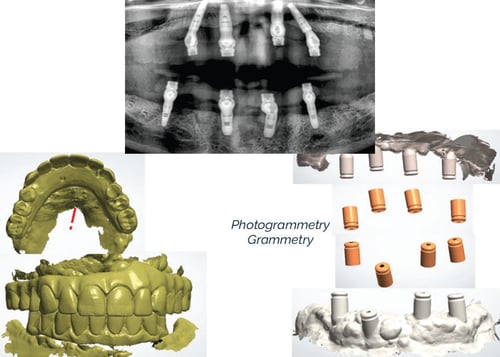
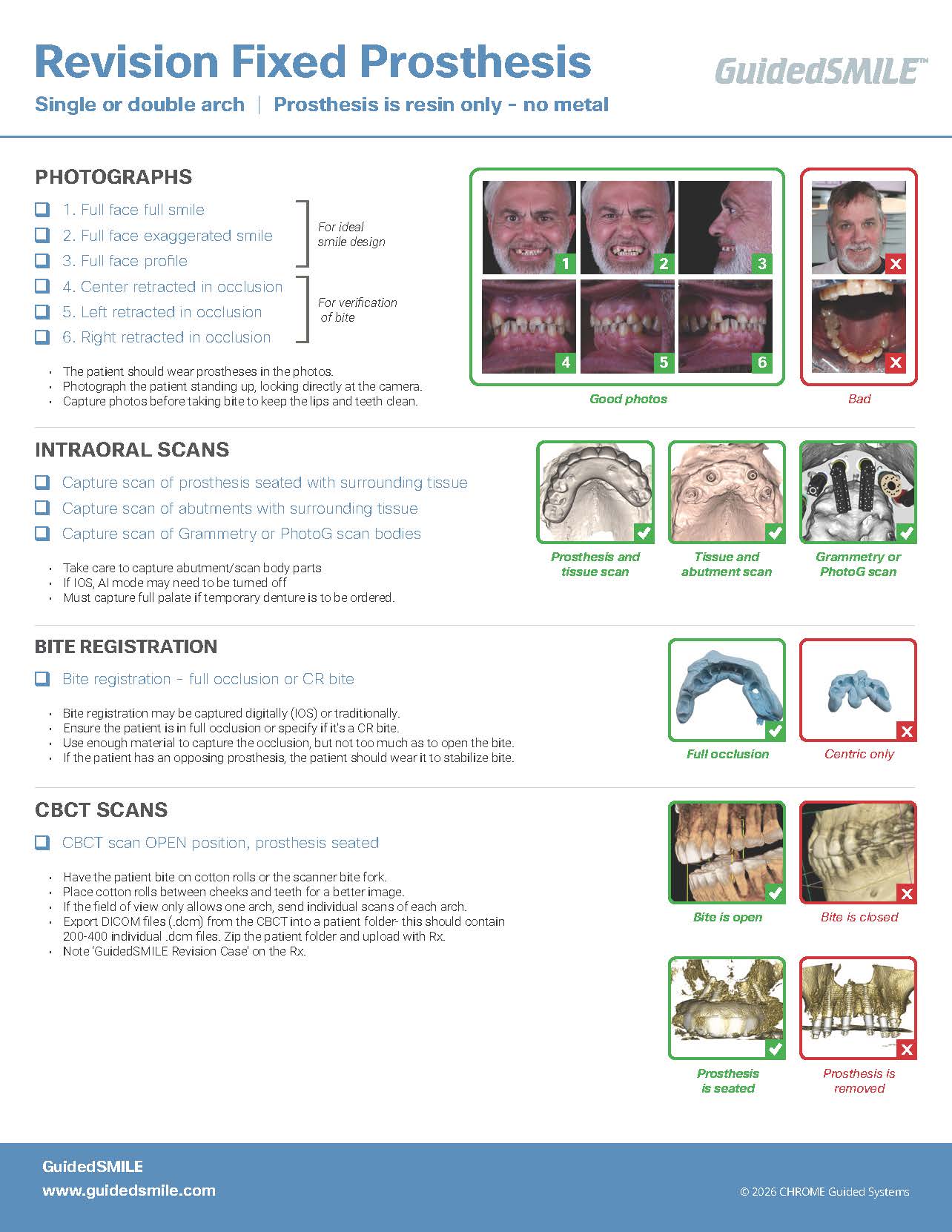
Every case follows a consistent digital workflow. Required records include:
- CBCT scan
- Upper and lower intraoral scans with bite registration
- 360° scan of the prosthesis outside the mouth
- Checklist-based clinical photographs
- Scan bodies or photogrammetry
Before a case is moved into the planning stage, every record is reviewed against our submission checklist to ensure the information is complete and ready for the next step.
Plan the case live with ROE
Meet online with ROE's full-arch planning team for a collaborative case review in RealGUIDE™. Every plan is driven by the restorative outcome and carefully developed with attention to:
- Implant positioning
- Pterygoid implant trajectories
- Fixation points
- Bone levels
- Symmetry and AP spread
- Reinforcement for parafunctional patients
ROE engineers and fabricates
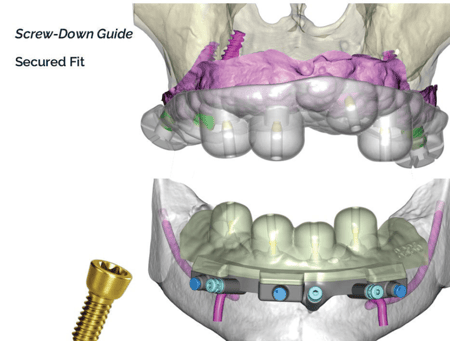
Your screw-retained surgical guide is designed around the existing prosthesis after it has been removed, providing the access needed for predictable revision surgery.
Choose the complete stackable GuidedSMILE workflow with surgery-ready prosthetics, or a streamlined CombiGuide™ for bone reduction and implant placement.
Screw down and place
Seat the guide on the abutments with balanced left-to-right engagement. Place the anterior implants first to establish the trajectory, then complete the posterior implants (including pterygoids) with fully guided surgery.
Finish by seating the stackable provisional, allowing your patient to leave with fixed teeth the same day.
Download Your Free CHROME GuidedSMILE
Ultimate Guide Now
What You'll Gain In This 90-Page Guide:
- Mastery of the 6-component & surgical protocol of the CHROME GuidedSMILE system
- Complete understanding of all necessary patient record requirements on a per-patient scenario
- Comprehensive day-of-surgery prosthesis conversation process
Available in digital or print format (free mailing included).
Case Study
This patient arrived with both arches failing and left with both rebuilt. His is a fixed to fixed revision from start to finish, and it shows the complete protocol working exactly as designed: photogrammetry-driven records, two arches planned on their own merits, and guides that screw down to the abutments instead of resting on tissue.
1. Two failing arches, captured completely
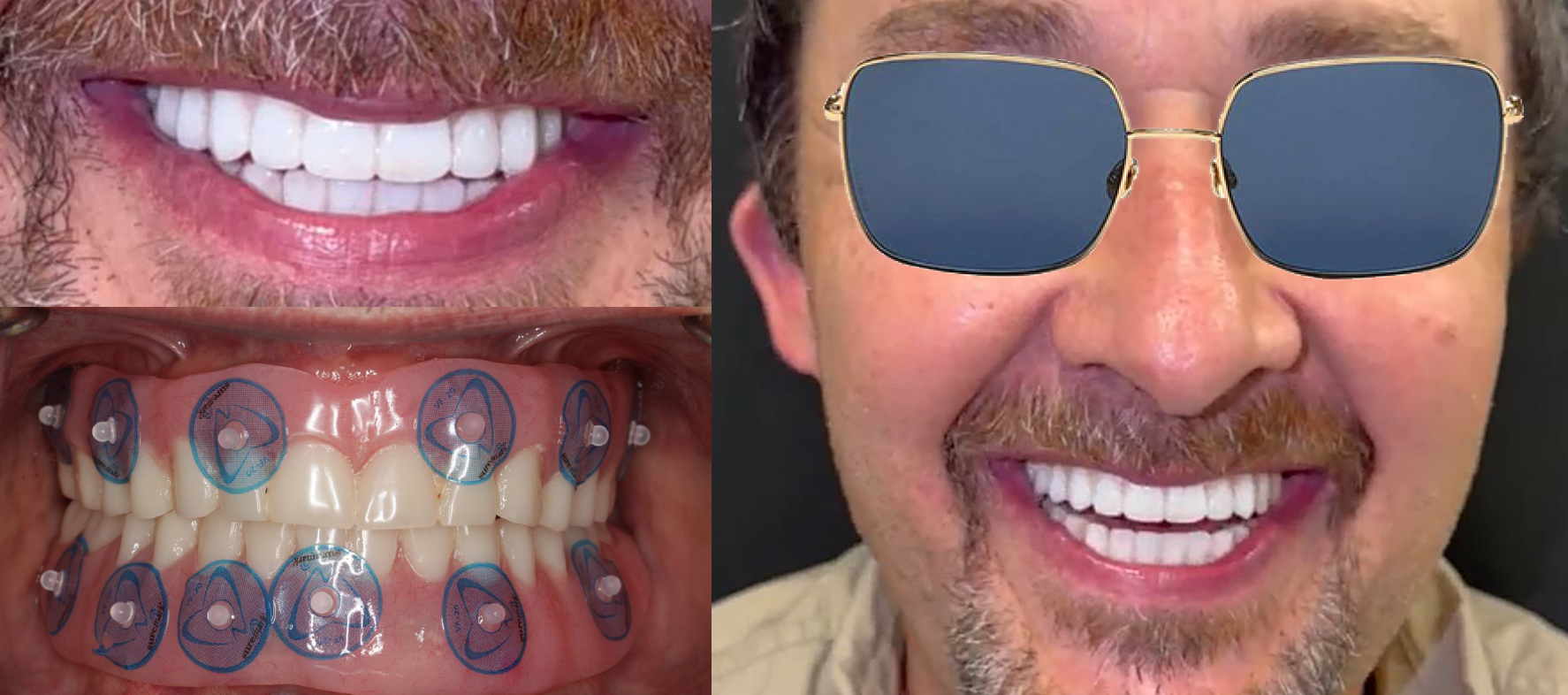
Jim came in with old, deteriorating prosthetics on both arches, some existing bone loss, and a bigger problem underneath it all: not enough prosthetic space. He needed more room, more implants, and new teeth top and bottom, placed in whatever bone he had left.
The records did the heavy lifting early. Micron Mapper photogrammetry captured the componentry positions on both arches, and an intraoral scan taken with the scan bodies still seated tied his tissue to those positions. His prosthetics were scanned in the mouth as upper, lower, and bite, then removed and scanned all the way around so the lab could stack everything and confirm exactly where the tissue sits. Good photographs finished the set. The first submission arrived missing one item, the 360 prosthesis scan. Intake flagged it, the office captured it, and planning started with nothing left to guess about.
2. A plan built from the face down
The patient had spent years in prosthetics that had stopped fitting his face. So before any tooth positions were locked in, his overjet and lip support were checked against the photographs. The new arches had to hold up his lips and profile, not just fill the space behind them.
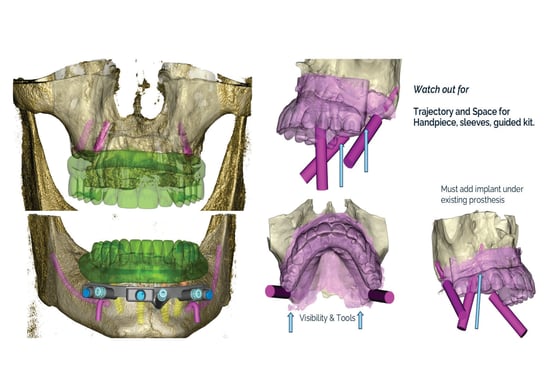
From there, each arch got its own plan. The upper kept his existing implants, added pterygoids for posterior anchorage, and picked up one more implant in the back. The patient was glad to hear that most of what he'd already paid for would keep working. The lower went the other way entirely: a full redo, because that arch needed more space, more AP spread, and more implant.
3. Clear the field, then screw it down
The old prosthetics came out before surgery. There was no room to bring the instrumentation in on the planned trajectories. The handpiece would have hit the posterior teeth. And one new implant was headed directly underneath where the prosthesis sat.
A tissue-supported guide wasn't considered for any of this. Pterygoid trajectories need real stability, so does threading implants between existing ones, and the patient had worn dental work long enough to notice slop. Both guides screwed straight down to his abutments: the engagement was checked left and right, torqued, and hand-tightened. The upper, with only three implants planned, used a simple, inexpensive guide priced closer to a traditional one.
4. Solid, on both arches
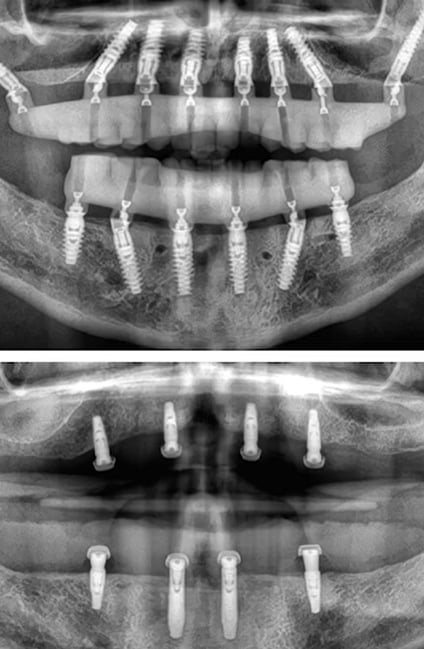
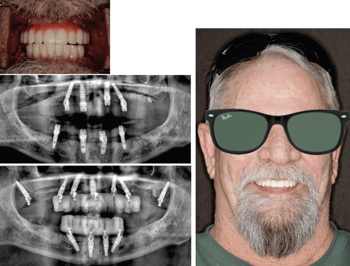
The patient walked in with prosthetics that had needed attention for years and walked out with a stable, engineered result. The post-op panoramics show a much more solid result.
This is what it looks like when that patient gets a protocol instead of a referral. Everything is decided upon during the planning phase, nothing freehanded in the chair. By the time the patient sat down for surgery, the hard thinking was already done.
Video Resources
Rescuing Failed or Failing All-on-X Cases
Introduction to GuidedSMILE
CHROME Animation
6 Components of CHROME
Dentate Surgery
Double Edentulous Surgery
How can we help you today?
Can't find what you're looking for? No problem. Let us help.
ROE’s experts are dedicated to elevating your dental practice.
- Full-service national dental laboratory
- Comprehensive Certified Dental Laboratory (CDL) services
- Case planning support from 20+ Certified Dental Technicians
- Specialists in both fixed, removable, implant and full-arch dentistry
- Tailored support for all cases, from routine to complex
- National Association of Dental Laboratories (NADL) member
- Only FDA-approved materials used
- All products made in the USA
- Thousands of free online education materials