
Introduction to the Locator Fixed System
The Locator Fixed system from Zest Dental Solutions represents a significant advancement in full arch implant dentistry. This innovative solution bridges the gap between traditional removable implant overdentures and screw-retained hybrid prostheses, offering dental professionals another valuable tool for treating edentulous and near-edentulous patients.
For clinicians already familiar with the Locator system for removable prosthetics, the transition to Locator Fixed is remarkably intuitive. The system uses the same abutments that practitioners have relied on for years, eliminating the steep learning curve often associated with adopting new implant technologies. This familiarity allows dental teams to expand their treatment offerings without investing significant time in mastering entirely new components and workflows.
Understanding Full Arch Implant Restoration Options
Before exploring the specific benefits of Locator Fixed, it helps to understand where this system fits within the broader landscape of full arch treatment options. Dental professionals today have access to an impressive array of solutions for edentulous patients, each with distinct advantages and clinical indications.
Traditional options include the Pro Arch or All-on-4 concept, which utilizes four implants with tilted distal fixtures to increase the anterior-posterior spread while avoiding anatomical structures like the maxillary sinuses and mental foramen (1). This approach minimizes the need for extensive bone grafting procedures. The All-on-6 or All-on-X configuration (e.g. CHROME GuidedSMILE) extends this concept further, leveraging research demonstrating that short implants, when placed properly, achieve success rates comparable to longer fixtures (2).
Removable solutions encompass two-implant and four-implant overdentures using attachment systems such as Locator or Novaloc. For patients with severely compromised anatomy, options include mini implants for extremely thin ridges and zygomatic implants for the severely resorbed maxilla (3). Locator Fixed now occupies a unique position within this treatment spectrum, offering fixed prosthetic outcomes with certain advantages over conventional screw-retained restorations.
How Locator Fixed Technology Works
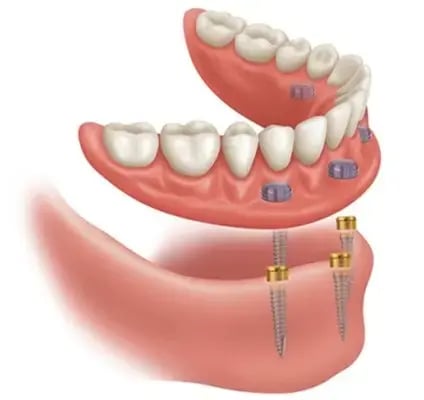
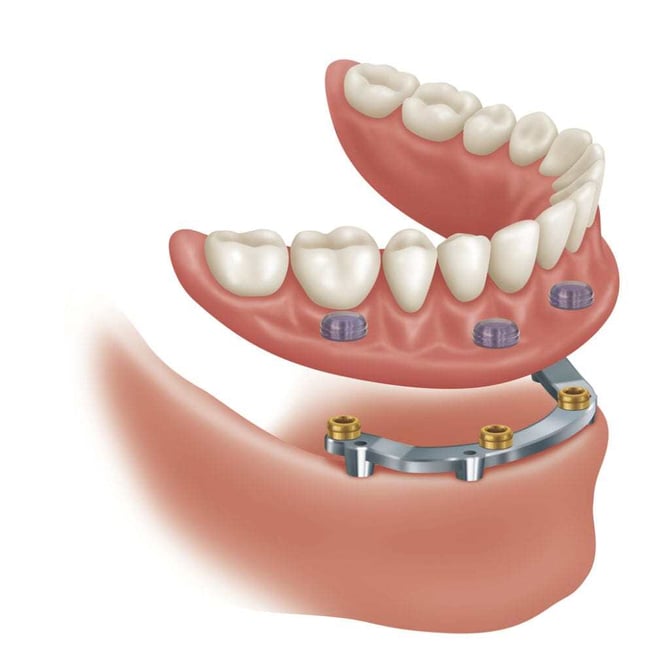
The Locator Fixed system applies existing, validated technology in a new clinical application. The abutments remain identical to those used in removable Locator cases, requiring no changes to ordering protocols or inventory management. This continuity extends to the processing inserts and intraoral pickup techniques, which mirror established workflows using chairside acrylic or self-curing materials.
The key innovations lie in two redesigned components. The housings have been reengineered for increased strength, ensuring they remain securely seated under the functional loads associated with fixed prostheses. The inserts are manufactured from PEEK (polyetheretherketone), a high-performance polymer that provides the rigidity necessary for fixed function while maintaining the system's characteristic ease of use (4).
One notable design advantage is the absence of screw access holes on the occlusal surface. In traditional screw-retained prostheses, fractures commonly occur at points where the material thins around metal cylinders and screw channels. The Locator Fixed design eliminates these stress-concentration areas, creating a smooth surface that patients find comfortable against their tongue while potentially reducing fracture risk.
The prosthesis features a flat intaglio surface rather than the convex contours typical of removable dentures. This design facilitates hygiene protocols similar to those for screw-retained restorations, allowing patients to clean effectively around and underneath the prosthesis.
Clinical Advantages of Reduced Restorative Space Requirements
One of the most compelling clinical advantages of Locator Fixed relates to restorative space requirements. Conventional All-on-X prostheses typically require 12 to 16 millimeters of vertical space to accommodate the various components and prosthetic materials. Locator Fixed prostheses function effectively within 8 to 12 millimeters of space, depending on the restorative materials selected (5).
This reduced space requirement carries significant implications for treatment planning and surgical execution. Surgeons can perform less aggressive bone reduction during alveoloplasty, preserving more of the patient's native tissue. For practitioners who express concern about irreversibly flattening a patient's ridge architecture, Locator Fixed offers a more conservative approach that maintains future treatment flexibility.
The space advantage proves particularly valuable when converting existing implant overdenture cases to fixed prosthetics. A common challenge in removable overdenture cases involves inadequate restorative space, often because implants were placed without sufficient alveoloplasty at the time of extraction. These cases may not accommodate traditional hybrid restorations but can successfully receive Locator Fixed prostheses due to the reduced vertical requirements.
Patient Pathways and Treatment Versatility
The Locator Fixed system accommodates multiple clinical pathways, allowing practitioners to match treatment approaches to individual patient circumstances and preferences.
Immediate loading protocols enable patients with hopeless dentition to receive a fixed Locator Fixed prosthesis on the same day as implant placement and extractions. This approach addresses a primary patient concern: the desire to avoid wearing a removable denture during the healing period. Practices offering immediate fixed solutions often become destination providers in their communities, attracting patients specifically seeking this outcome.
Delayed loading remains an appropriate protocol for cases where primary stability or other clinical factors warrant a healing period before prosthetic loading. Patients wear a transitional prosthesis while implants integrate, then return for fabrication of the definitive Locator Fixed restoration.
Conversion cases represent a growing segment of full arch treatment. Patients currently wearing removable implant overdentures may seek fixed alternatives for various reasons. Some find the maintenance schedule for replacing attachment inserts burdensome. Others experience food accumulation beneath their prosthesis that affects comfort and confidence. Research supports that fixed prostheses provide superior chewing function compared to removable alternatives, offering a meaningful quality-of-life improvement for these patients (6).
The Locator Life Concept and Long-Term Treatment Planning
Zest Dental Solutions has developed the Locator Life concept to illustrate how patients may progress through various prosthetic solutions throughout their lifetime. A patient might begin with a partial denture incorporating Locator attachments, advance to a two-implant overdenture as additional teeth are lost, progress to a four-implant overdenture, and ultimately transition to a Locator Fixed prosthesis.
This continuum approach supports patient-centered treatment planning by recognizing that needs evolve over time. Rather than viewing each prosthetic stage as an isolated intervention, clinicians can discuss long-term trajectories with patients and plan accordingly.
An important clinical consideration involves the reversibility of the Locator Fixed system. If a patient experiences complications such as peri-implantitis resulting in implant loss, the remaining fixtures can support a conversion back to a removable prosthesis. This flexibility means that patients are not locked into a fixed solution if circumstances change, reducing the stakes associated with choosing a fixed approach initially.
Cost Positioning and Patient Acceptance
The economic positioning of Locator Fixed creates opportunities to serve patients who might otherwise not proceed with fixed treatment. Traditional full arch screw-retained prostheses represent a significant investment, and the price differential between a four-implant overdenture and a fixed hybrid restoration can be substantial.
Locator Fixed occupies a middle position in the fee structure. While exact pricing varies based on materials, geographic location, and laboratory costs, the system generally allows practitioners to offer fixed prosthetics at a lower price point than conventional hybrid restorations. For some patients, a difference of several thousand dollars determines whether they accept fixed treatment or settle for a removable alternative.
This intermediate pricing tier does not compromise clinical outcomes. Rather, it reflects efficiencies in the system design and workflow that translate to value for patients seeking fixed prosthetic solutions.
The Importance of Comprehensive Case Workup
Successful outcomes with any full arch prosthesis, including Locator Fixed, depend on thorough case analysis and treatment planning. Regardless of the final prosthetic approach selected, the workup process should follow consistent protocols that prioritize understanding where teeth need to be positioned relative to existing or planned implant locations.
Restorative space evaluation stands as the single most critical planning element. Without adequate space for prosthetic materials, failures become inevitable. This assessment requires knowing the proposed tooth positions and comparing them against the three-dimensional location of implants, whether existing or planned.
For conversion cases involving previously placed implants, this evaluation may reveal that some fixtures cannot be incorporated into the new prosthesis due to positioning that conflicts with ideal tooth placement. Making these determinations before beginning treatment prevents complications and allows for realistic discussions with patients about what their specific anatomy permits.
Guided surgery has transformed full-arch treatment predictability. While some experienced surgeons achieve excellent results with freehand techniques, guided approaches generally produce more consistent outcomes, particularly when implants must avoid anatomical structures like the mental nerve or maxillary sinus. Virtual surgical planning eliminates surprises on the day of surgery and enables fabrication of provisional prostheses that fit accurately from the outset.
Digital and Analog Workflow Integration
Contemporary full arch practice benefits from multiple technologies that can be combined according to practitioner preference and case requirements. The evolution from freehand surgery to guided systems, from direct pickup techniques to photogrammetry and scanning protocols, provides options for customizing workflows.
Photogrammetry systems like PIC, ICAM, and Micron Mapper capture implant positions using extraoral cameras combined with intraoral scans. While highly accurate, these systems involve significant equipment investments that may not suit every practice. As an alternative, scan flag systems (often called Grammetry) offer a more accessible path to accurate implant-level impressions. Products like the ArchBridge, OptiSplint, Nexus, IO Connect, and Straumann Exact allow intraoral scanning with fixtures attached to the implants, creating precise digital models without specialized cameras.
The flexibility of the Locator Fixed workflow accommodates both digital and analog approaches. Practitioners can maintain familiar techniques while incorporating new technologies incrementally, rather than overhauling established protocols entirely.
Achieving Natural Aesthetics in Full Arch Restorations
Full arch prosthetics offer clinicians complete control over smile design elements that remain constrained in conventional fixed prosthodontics. When restoring individual teeth with crowns and bridges, factors like existing gingival architecture, adjacent tooth morphology, and tissue recession limit aesthetic possibilities. Full arch treatment eliminates these constraints.
Practitioners control the midline position, smile curve, papilla curve, buccal corridors, incisal edge placement, tooth proportions, plane of occlusion, and individual tooth contours. This comprehensive control enables truly customized aesthetic outcomes tailored to each patient's facial features and preferences.
The skills required for excellent full arch aesthetics derive from foundational removable prosthodontic principles. Understanding how to set denture teeth, modify tooth positions and angulations, and develop natural tissue contours translates directly to hybrid and Locator Fixed design. As one prominent clinician has observed, the best smile designers are dentists who understand basic prosthodontic principles and have mastered denture fabrication techniques.
Quality laboratory partnerships prove essential for translating clinical vision into prosthetic reality. Laboratories with technicians trained in traditional denture techniques bring invaluable expertise to full arch cases, even when final restorations are produced digitally. The artistic judgment developed through hand-setting teeth informs decision-making throughout the design process.
Adopting a Patient-Centered Treatment Philosophy
The availability of multiple full arch treatment options demands a patient-centered approach to case selection. Rather than funneling every patient toward a single preferred treatment, practitioners benefit from evaluating individual circumstances, needs, and preferences before recommending specific solutions.
This philosophy requires working as part of an interdisciplinary team, incorporating surgical and restorative perspectives into treatment planning. The goal is determining what approach best serves each patient's biology, functional requirements, aesthetic goals, and financial circumstances, then allowing the patient to make informed decisions about their care.
Comprehensive examination and case workup form the foundation of this approach. Practitioners who invest time in understanding the complete clinical picture, rather than reacting to problems as they arise, achieve more predictable outcomes and build trust with patients seeking long-term oral health solutions.
Summary
Locator Fixed by Zest Dental Solutions offers dental professionals a validated approach to fixed implant prosthetics that combines familiar components with innovative design enhancements. The system's reduced restorative space requirements, absence of screw access holes, PEEK insert technology, and workflow flexibility make it a compelling option for appropriate cases.
For practitioners already using Locator attachments in removable prosthodontics, adopting Locator Fixed requires minimal additional training. The system expands treatment capabilities without demanding mastery of entirely new techniques or components.
As with all full arch treatment, success depends on a comprehensive case workup, realistic assessment of restorative space, and commitment to patient-centered treatment selection. When these principles guide clinical decision-making, Locator Fixed can deliver predictable, aesthetic outcomes that transform patients' quality of life.
Article Citations
1. Maló P, et al. "Distally Tilted Implants According to the All-on-Four Treatment Concept." Journal of Clinical Medicine. 2022. PMC9140184.
https://pmc.ncbi.nlm.nih.gov/articles/PMC9140184/
2. Katalinić I, et al. "Outcomes of treatment with short dental implants compared with standard-length implants: a retrospective clinical study." Maxillofacial Plastic and Reconstructive Surgery. 2024;46:8. PMC10902233.
https://pmc.ncbi.nlm.nih.gov/articles/PMC10902233/
3. Balzarini D, et al. "Success Rates of Zygomatic Implants for the Rehabilitation of Severely Atrophic Maxilla: A Systematic Review." Journal of Clinical Medicine. 2022;11(16):4859. PMC9406716.
https://pmc.ncbi.nlm.nih.gov/articles/PMC9406716/
4. Aravind Kumar SS, et al. "Polyetheretherketone (PEEK) as a Biomaterial: An Overview." Cureus. 2023;15(9):e45171. PMC10536400.
https://pmc.ncbi.nlm.nih.gov/articles/PMC10536400/
5. Gonzaga L, et al. "Interocclusal space assessment for full-arch implant-supported prostheses." ITI Blog. March 2023.
https://blog.iti.org/clinical-insights/interocclusal-space-assessment-for-full-arch-implant-supported-prostheses/
6. Zygogiannis K, et al. "Implant Supported Fixed Restorations versus Implant Supported Removable Overdentures: A Systematic Review." Journal of Oral Implantology. 2016. PMC5175531.
https://pmc.ncbi.nlm.nih.gov/articles/PMC5175531/
Additional Resources
For more information concerning the ZEST Locator Fixed:Contact Information
For help with a Locator Fixed solution for your next case, contact ROE Dental Laboratory:
- Phone: (216) 663-2233
- Email: info@roedentallab.com